A Guide to the Michelin Guide

No, this article isn’t about that big, white, bubbly, and lowkey creepy Michelin man (sorry, not sorry). Instead, it’s about something else with an odd relationship to this French tire company. The Michelin stars. The widely renowned and recognized term Michelin stars is actually part of the Michelin Guides, a series of guidebooks that Michelin has published and consistently updated since 1900.

However, like all great things, it’s progressed quite a long way. In the beginning, brothers Edouard and Andre Michelin published the Michelin guide as they wanted to increase the demand for cars and, thus, tires. They released the first copy of the guide for French motorists, and consisted of information such as maps, tire repair and replacement instructions, car mechanics, gas stations, etc. In the next decade, they rapidly expanded the Guide to several other European countries (Algeria, Tunisia, Italy, Switzerland, Germany, Spain, Portugal, and many more).
They only started adopting restaurants into the Guide in 1922, after World War I. As this section of the Guide grew, the brothers recruited inspectors to visit and rate restaurants anonymously. In the next decade, they established a criteria and rating scale for the restaurants while utilized stars, ranging from zero to three stars. (Note how they use terms of a car drive).

One star: “A very good restaurant in its category.”
Two stars: “Excellent cooking, worth a detour.”
Three stars: “Exceptional cuisine, worth a special journey.”

As of 2024, they’ve expanded to 20+ countries and many cities, including Canada’s very own Toronto and Vancouver. Despite their change in the criteria description for one star, now described as “high-quality cooking, worth a stop”, everything remains the same. Stars often make up for a large portion of a restaurant’s success, and the acquisition or loss of a star can drastically affect the restaurant. Chefs yearn for stars (see Burnt or don’t; it’s not that good), and it often represents the hierarchy one achieves and maintains in the culinary world.
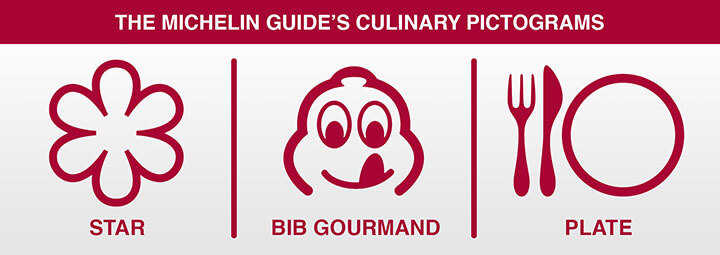
Stars, while significant, aren’t the only part of the restaurant section of the Michelin Guide. Since the 2000s, the Guide has promoted restaurants that offer exceptional food for moderate/affordable prices, a feature they deem “Bib Gourmand.” Most Michelin-starred restaurants often show $$$$, while Bib Gourmands cap out at $$. Along with Bib Gourmand, they’ve recently added an icon to symbolize excellence in sustainable gastronomy, the green star. When viewing the Michelin Guide, they also recommend other restaurants that don’t receive any of these honours, which are simply places that they think still offer a great dining experience, just not up to their sky-high standards.

Toronto has 81 restaurants on the Michelin Guide, of which 14 are one star and 1 is two stars. Although there’s a slight gap between us and France’s 630 Michelin stars, I’m sure we’ll catch up someday (probably not). In the end, the Michelin Guide is supposed to “guide”; their opinions and judgement aren’t final. Food is often subjective, and Michelin evaluates restaurants on more than just dining, considering the entire experience. Honestly, take the Michelin Guide with a grain of salt – star or not, it doesn’t necessarily define how good a restaurant is (ironic, as Quetzal is one of my favourite restaurants in Toronto).
Thanks, everyone, and Happy New Year!